

Did you know that the first act of the Civil Rights Movement was led by a 16-year-old wanting a better education? Meet BARBARA ROSE JOHNS, the teenage activist what helped change the face of public education in the United States.
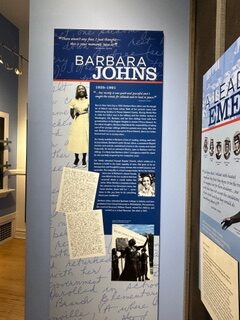
Until the 1960s, public schools were segregated thanks to a “separate but equal” ruling that allowed school districts to divide their population by race. While the white schools had access to newer buildings, sports equipment, labs, and textbooks, the black schools were given the castoffs—if they received anything at all. To make matters worse, by 1951 in Prince Edward County, Virginia the population of the black school was double the size it was designed for. To quell criticism, the county constructed tar paper shacks to house the students. These structures had no insulation, a potbelly stove for heat, and roofs that required buckets to be placed throughout the rooms when it rained. Students often had to wear coats and sit under umbrellas just to make it through class. Not an environment conducive to learning.
One student decided to do something about it.
16-year-old Barbara Rose Johns organized a student walk-out to draw attention to the appalling conditions. Her crazy, brilliant plan involved tricking the principal, convening an assembly while he was gone, and staging a walk-out. In short, she protected the adults while simultaneously uniting the students and raising awareness of the conditions.
Johns’ student-initiated action was championed by the NAACP and taken to court as Davis v. Prince Edward County. While this case may not be familiar to you, this one may: Brown v. Board of Education, of which the Davis case was one of five cases consolidated to make the larger argument. It was also the only case to be student initiated! That’s quite an accomplishment for a young teenager. So, why haven’t we heard of this before?
Until recently, this protest was not recognized as part of the broader Civil Rights Movement because of Johns’ age. However, given the timing and consequence of her actions, Johns is now viewed as the activist responsible for the first action taken in the Civil Rights Movement. Her fight for social justice is taught as part of Virginia history classes and in December 2025 her statue was unveiled as part of the National Statuary Hall Collection at the U.S. Capitol. Thanks to the tireless efforts of officials and politicians on both sides of the aisle, Barbara Rose Johns is finally getting the recognition she deserves.
To read more: